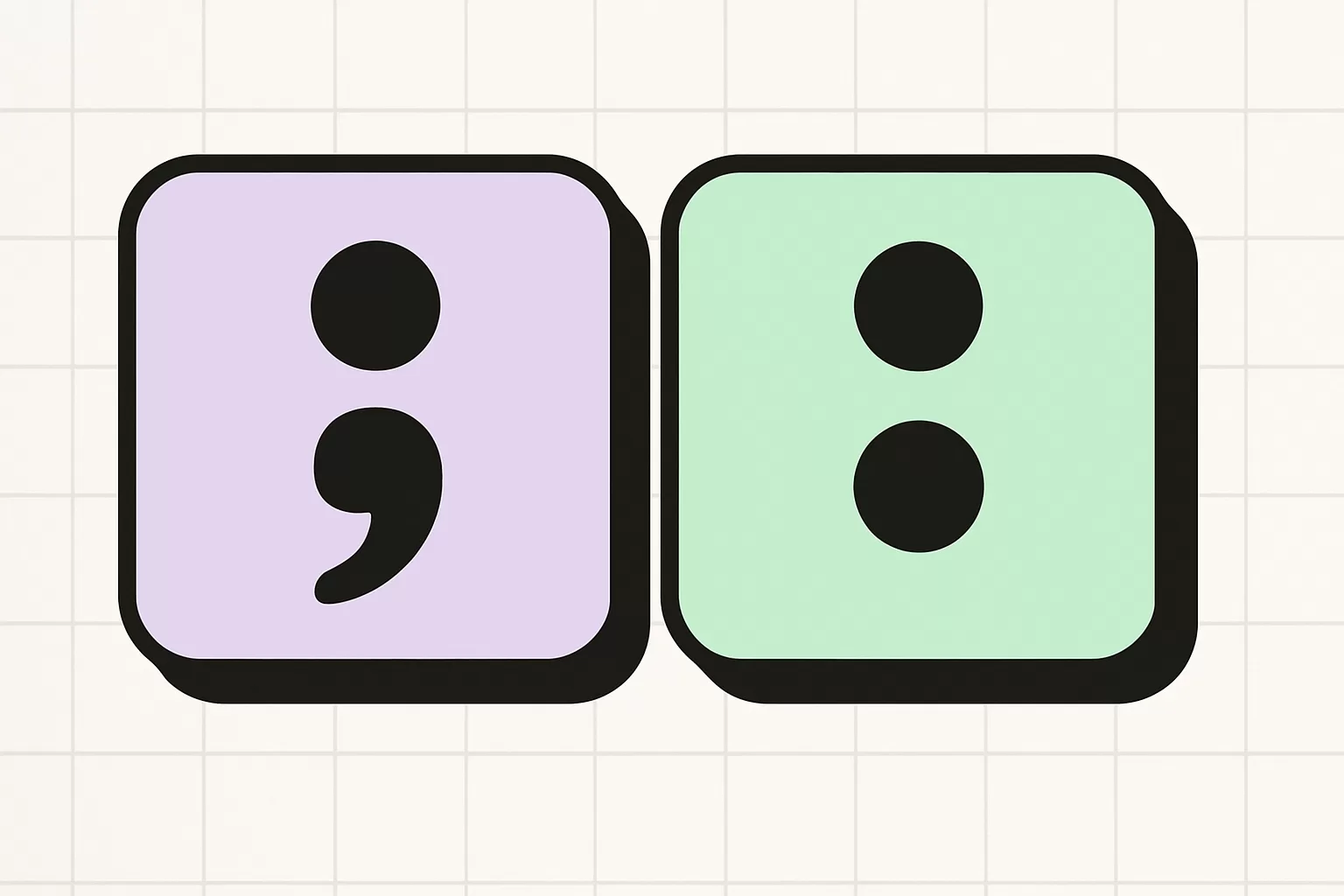
Choose a semicolon or colon by checking the sentence structure, then the meaning. Keeping the wording unchanged lets you see exactly what each punctuation mark does.
The use of a colon vs a semicolon: A direct answer
Use a semicolon to connect related complete statements. Use a colon when the first statement points forward to what follows. I’d start with these checks, rather than reading the sentence aloud and guessing from the pause.
For lists, the distinction is different: a colon introduces the list, while semicolons separate complex items within it.
- Check the introduction: Can the words before the mark stand alone as a sentence?
- Check what follows: A semicolon joining clauses needs another complete sentence; a colon can introduce a fragment.
- Choose the relationship: Use a colon for an explanation or specification, and a semicolon for related statements.
Semicolon vs colon grammar: What each mark does
An independent clause is a group of words that can stand alone as a sentence. “The library closed” is complete. “Because the library closed” leaves you waiting for the rest.
A semicolon normally joins independent clauses. Here’s an example: The library closed; we went home. Purdue OWL’s run-on guidance also shows a semicolon before a transition, followed by a comma. Applying that pattern gives us: The library closed; however, we kept studying.
A colon follows a complete introduction but can introduce either a sentence or a fragment. For example: We needed somewhere quiet: the library. Appalachian State University’s punctuation guide also explains its uses before lists, examples, explanations, and quotations.
Colons in times, ratios, titles, and formal greetings follow separate conventions. You don’t apply the complete-sentence test to those uses.
Grammar checker
Grammar checking covers English, German, Spanish, French, Italian, Dutch, Portuguese, Polish, Russian, and Arabic.
The result appears here once you run the tool.
Using a colon vs a semicolon with the same clauses
Compare: “I had one goal; I wanted to finish the draft.” Then change only the punctuation: “I had one goal: I wanted to finish the draft.”
The semicolon links related statements. The colon makes the second statement identify the goal. Neither version needs different wording to be grammatical.
Now compare: “We stayed inside; the roads were icy.” And: “We stayed inside: the roads were icy.” The colon presents the icy roads as the explanation. The semicolon leaves that relationship less explicit.
Semicolon vs colon examples with identical wording
| Mark | Opening clause | Effect |
|---|---|---|
| Semicolon | I had one goal | Related statement |
| Colon | I had one goal | Goal identified |
| Semicolon | We stayed inside | Related statement |
| Colon | We stayed inside | Reason emphasized |
Comma vs semicolon vs colon: The differences that matter
A comma alone cannot join independent clauses. Add a coordinating conjunction: “The room was noisy, so I left.” A semicolon gives you “The room was noisy; I left.”
In a semicolon vs colon vs dash comparison, the relevant dash is an em dash, not a hyphen. An em dash can introduce an explanation with a stronger interruption or emphasis.
For a semicolon vs colon vs em dash choice, check structure first, then choose the emphasis. Pause length isn’t a dependable sentence test.
Sentence structure and meaning
| Choice | Requirement | Relationship | Typical use |
|---|---|---|---|
| Comma + conjunction | Two complete clauses | Connection named | Link with and, but, or so |
| Semicolon | Two complete clauses | Closely related ideas | Link without conjunction |
| Colon | Complete introduction | Explanation follows | Explain or introduce |
| Period | Complete sentences | Separate statements | End a sentence |
Which mark fits your sentence?
Use a semicolon when both statements are complete and belong together. A period also works: “The draft is ready. The editor can review it.”
Appalachian State’s guide explains that semicolons separate list items containing other punctuation. Here’s an example: We packed apples, sliced; sandwiches, wrapped; and tea, bottled. The semicolons show where each item ends.
To introduce a list, write: “We packed the essentials: apples, sandwiches, and tea.” The introduction is complete without the list.
A colon need not introduce a list. It can introduce an example, “I noticed a recurring error: missing commas,” or a quotation, “The instruction was clear: ‘Save your draft.’”
Choose by the job the punctuation does
| Your sentence needs | Choose |
|---|---|
| Related complete statements | Semicolon or period |
| Explanation after an opening | Colon |
| List after a complete opening | Colon |
| List items containing commas | Semicolons |
Common mistakes and how to fix comma splices
Purdue OWL’s run-on guidance shows how a semicolon repairs an incorrect join between independent clauses. Both sides must be complete. A colon is another option only when the second part explains or specifies the first.
Don’t insert a colon between a verb and its object, or between a preposition and its object. Appalachian State’s guide identifies both errors. To introduce a list formally, rewrite the opening. For example: Pack these supplies: paper and pens.
A semicolon doesn’t itself trigger capitalization. Capitalization after a colon depends on context and style: Chicago’s current guidance recommends an initial capital for a complete sentence following a colon.
Check your revisions with Blurwrite’s free grammar checker. It checks punctuation and other writing issues, labels each issue, and offers a fix to apply or ignore. Then use the relationship test to choose the mark that expresses your meaning.
Before and after punctuation repairs
| Problem | Before | After |
|---|---|---|
| Comma splice | I wrote, you edited. | I wrote; you edited. |
| Dependent clause | I left; because it rained. | I left because it rained. |
| Colon after a verb | Pack: paper and pens. | Pack paper and pens. |
| Colon after a preposition | Write with: a pen. | Write with a pen. |
| Missing transition comma | I tried; however I failed. | I tried; however, I failed. |
Try some semicolon vs colon practice
Check the clauses first. Then ask whether the second part explains or specifies the first.
“I reviewed the draft ___ you checked the references.” Answer: semicolon. Both parts are complete, related statements.
Bring the following supplies ___ paper, pens, and folders. Answer: colon. A complete introduction points forward to a list.
“I stopped working ___ I was exhausted.” Answer: either. A semicolon links the statements; a colon presents exhaustion as the explanation.
Keep working on your own text
Free plan
0 USD
Check your text without a card. The same daily allowance applies here and on the tools.
Check grammarTop-up credits
Add words for rewriting when you need them.
- AI detectorfrom 4.99 USD
- Humanizerfrom 6.99 USD
- Paraphraserfrom 6.99 USD
- Summarizerfrom 7.49 USD
Questions about this article
When should you use a colon instead of a semicolon?
Use a colon when a complete introduction points forward to an explanation, example, list, or quotation. For example, “I needed one thing: a quiet room.” The words after the colon identify that thing. A semicolon wouldn’t fit here because “a quiet room” cannot stand alone as a sentence.
What is the difference between (;) and (:)?
A semicolon links related complete sentences or separates complex list items; a colon introduces material that explains or specifies what came before. Compare “I stopped writing; I was tired” with “I stopped writing: I was tired.” Both are grammatical, but the colon explicitly presents tiredness as the explanation.
When should you use a semicolon in a sentence?
Use a semicolon between closely related complete sentences without a joining word such as “and” or “but.” It also belongs before a transition like “however” when that word connects complete sentences. In a list, use semicolons to separate items that already contain commas, so readers can see where each item ends.
What are 10 examples of semicolons?
These examples show clause joins, transitions, and complex lists: “I read; you listened.” “The rain stopped; we left.” “I cooked; you washed up.” “The door opened; everyone turned.” “I tried; however, I failed.” “It rained; therefore, we stayed.” “She agreed; nevertheless, he hesitated.” “Bring bread, sliced; cheese, grated; and apples.” “We packed shirts, folded; shoes, cleaned; and hats.” “They served soup, hot; salad, chilled; and bread.”
How do you choose between a semicolon, a colon, and an em dash?
Choose a semicolon for related complete statements, a colon for an explanation after a complete introduction, and an em dash for a more pronounced interruption or emphasis. Check the sentence structure before choosing the effect. Don’t decide simply by how long you want the reader to pause.
Where can I practice choosing between a semicolon and a colon?
Start with the practice items below, then apply the same test to your own draft. Cover each answer, check whether the introduction is complete, and decide whether the next part explains it. For help reviewing your revisions, explore our writing tools for second-language writers.