To judge how accurate AI detectors are, start with what the result measures. Read it alongside the marked passages, then compare the original and revised drafts.
Are AI detectors accurate?
Accuracy depends on the detector and the writing. In the Patterns essay evaluation, the tested detectors correctly classified the US student essays but flagged more than half of the human-written TOEFL essays on average. That's a concrete reason to examine errors on writing like yours, not just a headline percentage.
Use a reading to direct your review. I'd start by checking your draft with the AI detector, which gives you one figure with a confidence rating and a mark on every sentence. Then follow these steps before deciding what to change.
- Check minimum length. Make sure your input meets the detector's stated requirement.
- Read the score definition. Establish what the figure and confidence rating mean.
- Preserve drafts and sources. Keep the material that shows how your writing developed.
- Review flagged passages. Compare sentence marks with your argument, quotations, and surrounding text.
- Revise and recheck. Compare before-and-after readings, then read the final draft for voice, facts, and citations.
How can AI detectors tell if writing is AI-generated?
Text detectors classify patterns associated with human and AI writing. Predictability offers a plain way to understand part of that process: repeated phrasing and similar sentence structures make wording feel more expected. A detector evaluates patterns across the text rather than treating a single word as the answer.
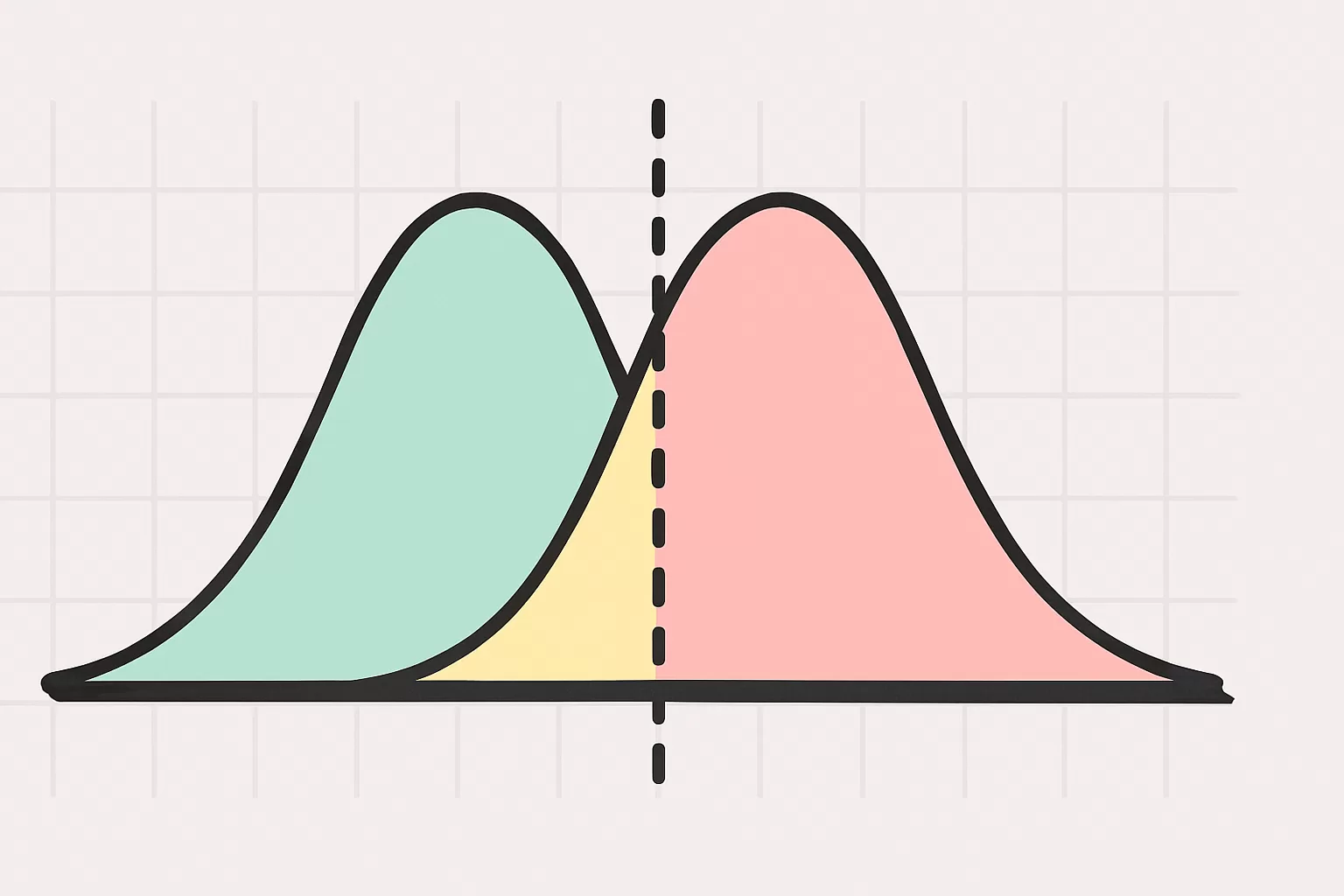
That classification process can produce different kinds of error. A false positive flags human writing; a false negative misses AI writing. Accuracy counts correct classifications overall, while precision and recall describe different parts of the result.
When comparing published figures, check what was counted. Whole-document classifications and passage-level marks measure different things. Also look at how much human and AI writing the evaluation included.
What the main evaluation measures mean
| Measure | Meaning |
|---|---|
| Accuracy | Correct test classifications |
| False-positive rate | Human texts wrongly flagged |
| False-negative rate | AI texts missed |
| Precision | Flags that were correct |
| Recall | AI texts found |
Paste a paragraph and check it
The result appears here once you run the tool.
What do published detector evaluations show?
The Patterns paper, GPT detectors are biased against non-native English writers, evaluated seven detectors. Its human-written material included 91 TOEFL essays and 88 US eighth-grade essays. The different results for those groups show why an evaluation needs to identify whose writing it tested.
The authors also used a language model to change vocabulary. Enhancing the TOEFL essays' vocabulary reduced misclassification, while simplifying the US essays' vocabulary increased it. These were machine-edited versions of human essays, not a test of students making their own revisions.
OpenAI's discontinued classifier supplies a historical comparison. On its English challenge set, it identified 26% of AI-written text as likely AI-written and incorrectly labeled human writing 9% of the time. OpenAI subsequently withdrew the classifier.
Those OpenAI figures measure different outcomes. The 26% identification rate isn't overall accuracy. The 9% false-positive rate describes errors among the human texts tested, not the share of all flags that were wrong.
Results from two published text evaluations
| Evaluation | Writing tested | Reported result |
|---|---|---|
| Patterns | Human TOEFL essays | Over half flagged on average |
| Patterns | Human US student essays | Correctly classified |
| Former OpenAI classifier | AI-written English text | 26% identified |
| Former OpenAI classifier | Human-written English text | 9% incorrectly flagged |
Is 20% AI detection bad?
Not automatically. You need to know what the percentage represents before deciding whether to revise. A proportion of flagged text, a classification score, and a published accuracy rate aren't interchangeable.
If a tool defines 20% as the proportion of text flagged, review the marked portion first. Check whether it contains repetitive explanations, quotations, or wording you want to revise. If the percentage is a classification score, use the explanation beside that score instead.
For Blurwrite, read the figure together with its High, Medium, or Low confidence rating and sentence marks. That combination gives you both a draft-level reading and specific places to inspect.
Read the percentage according to its definition
| Result type | What it describes | Your next step |
|---|---|---|
| Text proportion | How much text was flagged | Inspect marked passages |
| Classification score | Tool-defined score | Read the score explanation |
| Confidence rating | Confidence in the reading | Read beside the figure |
| Benchmark accuracy | Correct test classifications | Check the evaluation |
What changes for short or second-language essays?
Check the input length before judging a short passage. Blurwrite gives no reading under 50 words. From 50 to 99 words, its figure carries Low confidence and a short-text note.
For a second-language essay, look for evaluations that include non-native writing. Blurwrite calibrates each supported language separately, including writing by non-native speakers. It also measures false positives on non-native writing.
If your draft combines your own writing, quotations, and AI-assisted revisions, review the marked passages individually. Keep quotations intact and check their citations. Your notes and earlier drafts help you understand how each passage developed.
Adjust the review to the text you're checking
| Writing condition | What to check |
|---|---|
| Under 50 words | Blurwrite gives no reading |
| 50 to 99 words | Low confidence and text note |
| Second-language essay | Check relevant evaluation |
| Mixed-authorship draft | Review passage by passage |
How to review and revise a flagged essay
Start with the wording, not a blanket rewrite. Look for filler, repeated sentence shapes, and phrases that don't sound like you. Keep the original claim and its qualifications.
Before: “Public libraries play an important role in providing access to reading materials. By lending books at no cost, they allow residents to read without purchasing each title. This service can make reading more accessible to people with limited budgets.”
After: “Public libraries give people access to reading materials. Residents can borrow books for free instead of buying each title. For people on limited budgets, that service can make reading more accessible.”
The revision removes wordy phrasing and changes the sentence rhythm. It keeps the same claims, including the qualification that the service can improve access.
For a stiff draft, edit by hand or use the AI humanizer to make it read naturally while keeping names, numbers, and quotations. Compare the before-and-after detector readings, including confidence ratings and sentence marks. Then do the final read for voice, meaning, facts, and citations.
To put those readings in context, see the measured rates by language on our accuracy page. Use those published measurements when evaluating Blurwrite's performance, and the sentence marks when reviewing the draft in front of you.
Keep working on your own text
Free plan
0 USD
Check your text without a card. The same daily allowance applies here and on the tools.
Check textTop-up credits
Add words for rewriting when you need them.
- 50,000 words4.99 USD
- 150,000 words11.99 USD
- 500,000 words29.99 USD
Questions about this article
Is it possible for an AI detector to be wrong?
Yes. A false positive flags human writing, while a false negative misses AI writing. Both matter when you evaluate accuracy. For your draft, inspect the marked passages and confidence rating, then compare the wording with earlier drafts, notes, and sources to decide what needs attention.
Is 20% AI detection bad?
No, 20% isn't automatically a bad result. Read the product's explanation of that percentage first. If it represents a proportion of flagged text, inspect those passages. If it represents a classification score, interpret it using that tool's definition. Don't treat the number alone as a passing or failing grade.
How can AI detectors tell if it's AI?
They classify writing patterns associated with AI-generated text. Predictability helps explain the idea: repeated phrasing and similar sentence structures create a regular pattern. Blurwrite returns one figure with a confidence rating and a mark on every sentence, helping you find the passages to review rather than searching for a particular banned word.
Are AI detectors accurate for academic writing?
They're useful for screening an academic draft and locating passages to review. To evaluate accuracy, look for results on comparable essays, including second-language writing when relevant. The Patterns study tested human-written TOEFL and US student essays, showing why the writing included in an evaluation matters for interpreting its results.
Can editing change an AI detector's reading?
Yes. The Patterns study found changed readings after a language model altered vocabulary in human-written essays. For your revision, compare the before-and-after figure, confidence rating, and sentence marks. Then read the final draft for meaning, voice, facts, and citations so the changes serve the writing as well as the detector check.
How do I check an AI detector's accuracy?
Look for published results that identify the writing tested and report errors on both human and AI text. Check the language, genre, length, and whether results cover documents or passages. Compare the same measure across evaluations: an AI identification rate and an overall accuracy rate answer different questions.